


What Is an SEO Score?
An SEO score is some sort of rating that an audit tool dishes out to your website (or an individual page) on a scale of 0-100, based on how many technical and on-page SEO problems its crawler can find. The fewer issues you have, the higher your score will be.
Here’s what a lot of people seem to get wrong: there is no SEO score from Google that is. Every “score” you see out there comes from a third-party tool, and each tool calculates it in its own little way. That’s why you can see the same site scoring 92 in one tool and 74 in another, and scratch your head trying to figure out why.
How the Big Players Calculate Their Scores
- Ahrefs (Health Score): Ahrefs does this crazy calculation where it takes the number of internal URLs with no major issues and divides that by the total number of internal URLs it crawled, and then multiplies by 100. Only real “Error” issues will bring that score down – warnings and notices just get ignored. And of course, Ahrefs is the one saying that here.
- Semrush (Site Health): Semrush makes the site health score a percentage, based on how many errors and warnings it finds versus how many checks it did in total. And here’s the thing – errors count a lot more than warnings. Plus, Semrush is also pretty keen on letting you compare your score against where the top 10% of sites are at. Semrush
- Google Lighthouse / PageSpeed Insights (SEO score): This one is a bit different – it only gives a score for a single page, not the whole site. Every automated check counts equally, so each passing audit adds about 8 points to the total.
You May Also Like

How to Check Your SEO Score: Tools and Techniques
Many tools can check a website’s SEO score. Some popular ones are:
- Ahrefs (which offers a free version if you own the site)
- SEMrush
- Moz
- Ubersuggest
These tools analyze a website’s SEO factors and give a score based on how well the site is optimized.
Using Google Search Console for SEO Insights
There are free tools such as Google Search Console that can provide insight on search performance, traffic patterns, all the keywords on which you are being seen on search results pages (SERPs) and so on — all of which provide valuable information that can be leveraged for future optimization.
It offers information about a site’s search traffic, keywords, backlinks and more. This data can be used to find SEO problems and areas for improvement.
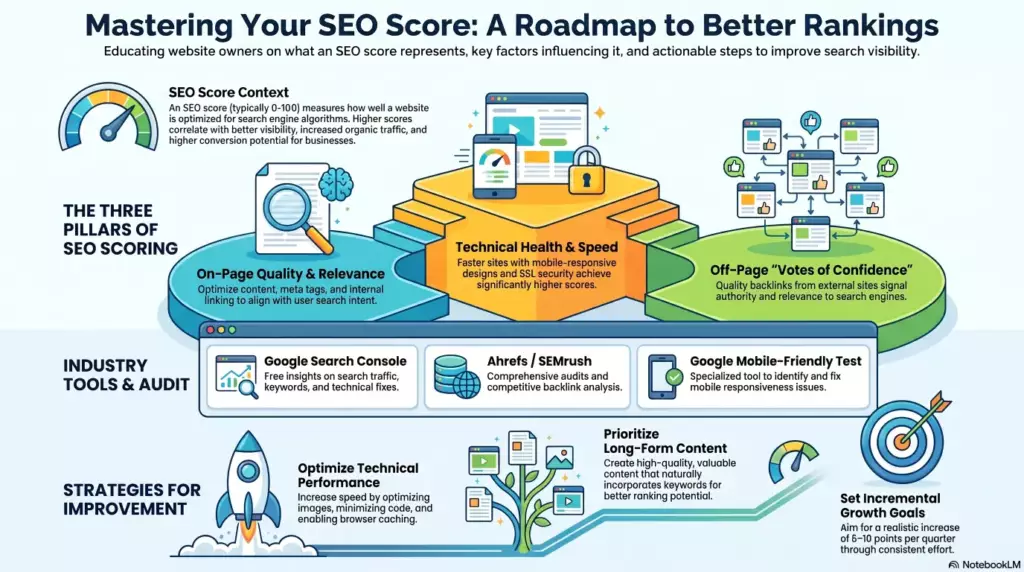
An SEO score is typically a number between 0 and 100. A higher value indicates better tuning. The score itself is less important than the particular factors it’s based on. To know where an SEO audit report needs changes, you need to dig deeper into the individual aspects.
What Factors Affect Your SEO Score?
On-Page SEO Factors That Influence Your Score
On-page SEO relates to elements on a website that influence its search rankings. This includes:
- Content quality and relevance
- Keyword usage in titles, headings, and body text
- Meta descriptions and alt tags
- URL structure and internal linking
Off-Page SEO Factors and Their Influence
Off-page SEO refers to factors outside a website that affect its ranking. The primary off-page element is backlinks from outside the website. Backlinks are considered as votes of confidence in a website’s quality and relevance by the search engines. The more quality backlinks a site has, the higher its SEO score will be.
Important Technical SEO Elements
Technical SEO relates to the backend elements of a website that affect its visibility on the search results. Important technical SEO factors are:
- Speed and performance of the website
- Mobile-friendliness and mobile responsiveness
- SSL security and HTTPS usage
- Sitemaps and the robot.txt file
Effective Ways to Improve Your SEO Score
Creating high-quality, relevant content is one of the best ways to improve SEO scores. Content should be written for users first, but also include keywords naturally. Long-form content tends to rank better than short, thin content.
Website speed is a key factor in SEO scores. Faster sites rank higher and have lower bounce rates. Some ways to speed up a site are:
- Optimizing images and videos
- Minimizing code and redirects
- Using a content delivery network (CDN)
- Enabling browser caching
Building Quality Backlinks and Authority
Building backlinks is an ongoing process that requires time and effort. Some effective link-building strategies are:
- Creating valuable content that others want to link to
- Guest posting on relevant websites
- Partnering with influencers and thought leaders
- Earning links through public relations and outreach
Common SEO Issues That Lower Your Score
Duplicate content is when the same or similar content appears on multiple pages of a website. This can confuse search engines and lower SEO scores. To fix duplicate content, use 301 redirects, canonical tags, or meta robots tags to tell search engines which version to index.
Broken links and 404 errors happen when a page no longer exists or a link is incorrect. These issues can hurt user experience and lower SEO scores. Use tools like Screaming Frog or Google Search Console to find and fix broken links and 404 errors.
With more people using mobile devices to browse the web, mobile-friendliness is a key factor in SEO scores. Websites that aren’t mobile-responsive may rank lower in search results. Use Google’s Mobile-Friendly Test tool to check for mobile issues and work with a developer to fix them.
The Future of SEO Scoring
As artificial intelligence (AI) and machine learning advance, they will play a bigger role in how search engines evaluate websites. AI can analyze user behavior and engagement metrics to determine which sites provide the best user experience. SEO scores of the future may put more weight on these factors.
User experience (UX) metrics such as click-through rate, bounce rate, and time on page are becoming increasingly important for SEO. Google has stated that UX will be a ranking factor in its upcoming Page Experience update. Websites with good UX are likely to have higher SEO scores in the future.
Tracking Your SEO Score Over Time
Improving an SEO score takes time and consistent effort. It’s important to set realistic goals based on a website’s current score and resources available. A good goal might be to increase a site’s score by 5-10 points per quarter, depending on its starting point.
Tools like Google Analytics can track a website’s traffic, rankings, and user engagement over time. This data can show whether SEO efforts are paying off and where there’s room for improvement. It’s important to regularly review analytics and adjust SEO strategies based on the results.
SEO is an ongoing process that requires adaptation as algorithms and best practices change. If an SEO score drops suddenly, it’s important to investigate why and make changes accordingly. This might involve updating old content, fixing technical issues, or building new backlinks. The key is to stay proactive and continually work on improving SEO over time.
In conclusion, a website’s SEO score is a crucial metric for its online success. By understanding the factors that influence SEO scores and taking steps to improve them, website owners can boost their search rankings, drive more organic traffic, and ultimately achieve their business goals. Staying up-to-date with SEO trends and best practices is essential for long-term success in the ever-evolving world of search engine optimization.
Ready to Make SEO Pay for Itself?
Stop paying for promises – start paying for performance. Our experts will revolutionize your search visibility with no upfront costs.