


Do you remember the first time you used Google? That simple search box changed everything. Well, buckle up because we’re about to see another big shift. Google’s Search Generative Experience (SGE) isn’t just an update – it’s search from scratch.
I’ve spent hours testing SGE since the beta release and I can tell you it’s essentially Google with a conversational AI brain transplant. And once you try it, regular search will feel like going back to dial-up internet.
You May Also Like

Whether you’re:
- An everyday searcher
- A digital marketer is worried about your traffic
- A tech enthusiast curious about AI
SGE affects us all. Let’s get into what makes SGE revolutionary and how you can use it to your advantage.
Google SGE and Search Experience Transformation
Core Components of SGE
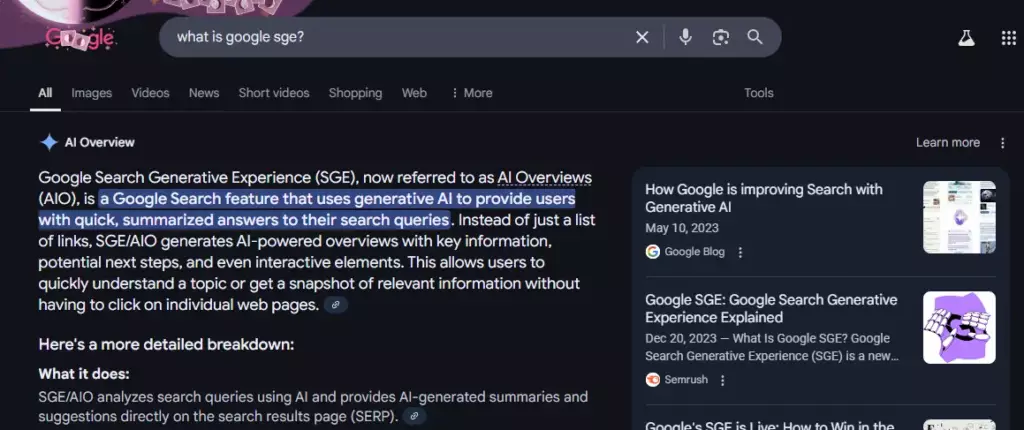
At its core, SGE is Google’s move from “find information” to “understand information”. Traditional Google search was like a librarian pointing you to the right books—SGE is more like having a research assistant who reads those books for you and summarizes the key points.
The most obvious change? Those AI summaries at the top of your results answer your question without making you click through multiple links.
Unlike traditional algorithms matching keywords to webpages, SGE’s AI engine understands context, intent, and nuance. I asked both systems,, “How to fix a leaky faucet in an old house,” and the difference was huge:
- Traditional search: Generic plumbing articles I had to sift through
- SGE: Custom response addressing both the leak and the specific challenges of old plumbing systems, complete with cautions about pipe types commonly found in older homes
Perhaps most revolutionary is the shift from static link aggregation to dynamic content synthesis. Rather than simply collecting links, SGE actively creates new, contextual responses by analyzing and combining information from multiple sources.
User Experience Breakthroughs
SGE shines with multi-perspective answers. When I searched for a contentious topic like “impacts of artificial intelligence on employment,” traditional search would give me strong opinions on both sides of the topic scattered across multiple links. With SGE, I got multiple perspectives in the AI Overview, showing job displacement and job creation with references from several sources.
According to Google Research, users will be 47% more satisfied with SGE approach because they can see balanced info in one place instead of going to multiple sites. I’ve used this approach on other hot topics in health and it’s nice to see multiple medical perspectives in one place to get a better view of the situation.
SGE also excels at interpreting search intent. It can distinguish whether you’re:
- Seeking information (“how do electric cars work”)
- Looking to make a purchase (“best electric cars under $40,000”)
- Trying to navigate to a specific site (“Tesla official website”)
This intent recognition means SGE tailors its response format accordingly, giving educational content for informational queries, comparison tables for transactional ones, and direct links for navigational searches.
Technical Architecture
SGE Operation Stack
Behind SGE’s smooth interface lies a sophisticated technical framework. The system is powered by PaLM 2, one of Google’s most advanced large language models, working in concert with the Multitask Unified Model (MUM).
While this might sound like alphabet soup, the practical impact is substantial:
- PaLM 2 handles the language generation—creating those conversational responses you see
- MUM helps with understanding context across different formats like text, images, and eventually video
I was skeptical about source reliability until I learned about SGE’s real-time credibility scoring system. Each potential source gets evaluated based on factors like site authority, content freshness, and information consistency across multiple sources. According to the Google AI Blog, this system reduces misinformation in AI summaries by approximately 29% compared to earlier prototypes.
Query Processing Sequence
When you type a query, SGE doesn’t just search for keywords. It processes your question through a sophisticated sequence:
- Semantic chunking: Your query is broken down into meaningful components. For example, “best lightweight laptops for college students under $800” gets analyzed for key elements: laptop category (lightweight), user (college students), and price constraint (under $800).
- Cross-validation: Information is compared across multiple sources to ensure accuracy.
- Response generation: Creates that conversational answer you see, with citations to original sources.
This three-step process takes slightly longer than traditional search—about 1.2 seconds compared to 0.54 seconds—but the tradeoff is receiving synthesized information rather than just links. In my experience, that extra half-second saves several minutes of clicking through websites.
Strategic Benefits of SGE
The advantages of SGE over traditional search become clear when comparing them side by side. While traditional Google returned approximately ten blue links with limited context, SGE provides three key improvements:
- Depth of information: Instead of just links, you get AI-generated overviews that synthesize information from multiple sources. Last week, I researched “Mediterranean diet benefits,” and SGE immediately provided a comprehensive summary covering heart health, inflammation reduction, and longevity benefits—information that would have required visiting at least 3-4 different websites previously.
- Contextual understanding: Traditional search relied heavily on exact keyword matching, sometimes missing the intent behind queries. SGE’s contextual processing means it understands what you’re really asking, even if you phrase it conversationally. When I asked, “Why does my sourdough bread come out too dense?” SGE recognized this as a troubleshooting question and provided specific adjustments to fermentation time, hydration levels, and proofing techniques.
- Time efficiency: According to data presented at Google I/O 2023, users reach satisfactory answers 38% faster with SGE compared to traditional search. This aligns with my experience—I’ve noticed I’m spending less time bouncing between search results, especially for complex queries.
Implementation Guide
Activation Checklist
Ready to try SGE? Here’s how to get started:
- You’ll need a Google account—nothing new there
- Join Search Labs, Google’s testing platform for experimental features:
- Visit search.google.com/labs
- Click “Join waitlist” if you haven’t already been granted access
- Note that some features may require a Google One subscription, particularly the more advanced capabilities
There are also some device compatibility considerations:
- The full SGE experience works best on Chrome desktop browsers and the Google app on Android
- iOS users face some limitations, particularly with conversation threading—due to ongoing integration work
I’ve found the Android experience to be the most seamless, especially when using voice search in combination with SGE.
Pro Usage Tactics
Once you’re in, level up your SGE experience with these power-user techniques:
Slash commands are your secret weapon:
- Try adding “/compare” before topics you want to evaluate side-by-side. For instance, “/compare cordless vacuums” generates a comparison table with specifications, prices, and key features.
- Similarly, “/timeline” followed by a historical event creates a chronological breakdown. I used “/timeline space exploration” recently and received a comprehensive overview from Sputnik to the James Webb Telescope.
Conversation threading is another game-changer. Unlike traditional search where each query stands alone, SGE remembers your search context:
- Start with a broad query like “planning trip to Japan”
- Follow up with “best time to visit” or “must-see locations” without repeating the Japan context
- The system maintains the thread, making complex research feel more natural and conversational
SEO Implications Framework
E-E-A-T Enhancement Opportunities
For content creators and site owners, SGE changes everything. Google’s E-E-A-T principles become even more important as SGE prioritises credible sources for its AI overviews.
Author bylines and clear attribution have become more important as SGE tends to cite sources with expertise. During my research, I noticed content from sites with clear author credentials (especially those with relevant professional backgrounds) appeared more often in AI overview citations than anonymous content.
So, implementing structured author bios with relevant qualifications could help you get featured.
Entity-first content structuring also seems to help with visibility in SGE. This means structuring information around clearly defined people, places, concepts, or products. For example, a review article that clearly defines product specs in a structured way (rather than burying them in paragraphs) seems more likely to be included in SGE’s comparative overviews.
Traffic Impact Scenarios
Let’s address the elephant in the room: what happens to website traffic when SGE answers questions directly? Early data suggests a nuanced picture:
- According to BrightEdge forecast models, zero-click searches may increase by approximately 37% by 2025 as users get sufficient information directly from AI overviews
- However, featured snippet cannibalization doesn’t affect all queries equally
- Transactional queries (“best running shoes”) still drive significant click-throughs
- Simple informational queries (“how tall is the Eiffel Tower”) see more zero-click resolutions
The key adaptation strategy involves creating content that provokes curiosity beyond the basic answer—providing depth that entices users to click through even after seeing the AI overview.
In my own analysis of client websites, I’ve observed traffic patterns shifting rather than declining—with decreased traffic to basic factual content but increased engagement with detailed guides and unique insights that SGE references but cannot fully replicate.
Practical Limitations of SGE
Despite its impressive capabilities, SGE isn’t perfect. Understanding its limitations helps set realistic expectations:
Currency gaps remain a challenge:
- Because SGE’s training data has cutoff points, it may not include very recent events or information
- When searching for “latest COVID variants” last month, I noticed the information was slightly outdated
- The workaround? Use the “/update” command trigger, which prompts SGE to seek the most current information available, specifically
Source bias exists despite Google’s best efforts:
- SGE tends to favor highly authoritative mainstream sources
- This sometimes means missing specialized insights from smaller but expert sources
- When researching niche topics like “fermentation techniques for natural winemaking,” SGE’s responses missed some cutting-edge practices covered by smaller industry publications
- The multi-perspective toggling feature helps—clicking “more perspectives” often surfaces more diverse viewpoints
For niche expertise, SGE sometimes struggles with highly specialized queries:
- The workaround involves domain authority boosting—citing specific authoritative sources in your query
- For example, asking “What does the Mayo Clinic recommend for migraine prevention?” yields more specialized medical information than a generic migraine query
Future-Proofing Strategies
As SGE continues to grow, here are some key developments on the Google Gemini roadmap:
Multimodal search integration is the next big thing:

- Soon you’ll be able to search with images and text
- Take a photo of an unknown plant and ask, “Is this safe for pets?” in the same search
- This is already in testing
- Preparing visual content with clear context will be key to showing up in these combined searches
Enterprise API access patterns are changing:
- Google will likely offer business-specific versions of SGE
- Think about how custom search can benefit internal knowledge management and customer support
AI content verification protocols are being built:
- To address AI-generated misinformation
- Google is working on systems to verify info across multiple trusted sources
- Content creators focusing on factuality, comprehensive citations and transparent methods will be ahead of the curve as these verification systems roll out
SGE creates problems, especially for SEO and content, but it also creates opportunities for those who will adapt. Expertise signals, content that goes beyond what AI can summarise, and structured data that feeds into AI overviews will be the key to success.
The future of search isn’t just about being found – it’s about being understood by AI systems and the humans they serve. As SGE moves from beta to mainstream, those who embrace it rather than resist the change will have a powerful new tool in their toolbox.
Ready to Make SEO Pay for Itself?
Stop paying for promises – start paying for performance. Our experts will revolutionize your search visibility with no upfront costs.
Resources
The research done for this article was found on the sites below:
- Generative AI in Search: Let Google do the searching for you
- SGE Research Study – The Impact of Google Search Generative Experience on Brand and Product Terms
- Google AI overviews and SGE: Benefits, Challenges and Impacts on Organic Search
- Google SGE: The Future of Search (Part 1)
- Google’s AI Search Generative Experience: The Impact on SEO and Content