


What is Value-Based Bidding in Google Ads?
Value-based bidding (VBB) enables advertisers to prioritize conversions differently based on their value to your business. Unlike traditional bidding strategies, which focus solely on maximizing conversion volume, VBB allows you to assign specific values to various actions, directing Google’s bidding algorithms to optimize for higher-value outcomes.
Think of it this way: not all conversions are created equal. A customer who makes a $500 purchase is objectively more valuable than one who makes a $50 purchase. Similarly, in lead generation, some actions (like booking a consultation) may be worth more to your business than others (like downloading a white paper).
You May Also Like

Traditional bidding strategies like “Maximize Conversions” count the number of conversions without distinguishing their value. They focus on tallying total conversions and maximizing volume, which can lead the algorithm to pursue the “path of least resistance,” often favoring easier but potentially less valuable conversion actions.
Value-based bidding represents a significant advancement in Google Ads automation, allowing businesses to align their advertising spend more precisely with their actual business goals and profitability metrics.
How Does Value-Based Bidding Work in Smart Bidding?
The mechanics of value-based bidding are surprisingly straightforward. When you implement VBB, Google’s AI optimizes bids in real time to reach people who are likely to bring more value to your business. You specify the value you want to maximize—whether it’s sales revenue, profit margins, or lead scores—when setting up conversion tracking.
For example, if a form submission typically leads to a $100 sale while a phone call typically leads to a $300 sale, you can assign these values accordingly. The algorithm will then prioritize bidding strategies that generate more phone calls, as they’re three times more valuable.
At auction time, VBB seeks to optimize for these most valuable outcomes as defined by your assigned values. It can also function with a target Return on Ad Spend (tROAS) to align with specific profit goals.
The bidding system makes automatic adjustments based on numerous signals, including:
- User device
- Location
- Time of day
- Remarketing lists
- Browser type
- Operating system
These adjustments happen in real-time for each auction, allowing for highly personalized bid optimization that traditional manual bidding simply cannot match.
What Are the Different Types of Value-Based Bidding Strategies?
Google Ads offers several value-based bidding strategies tailored to different business objectives:
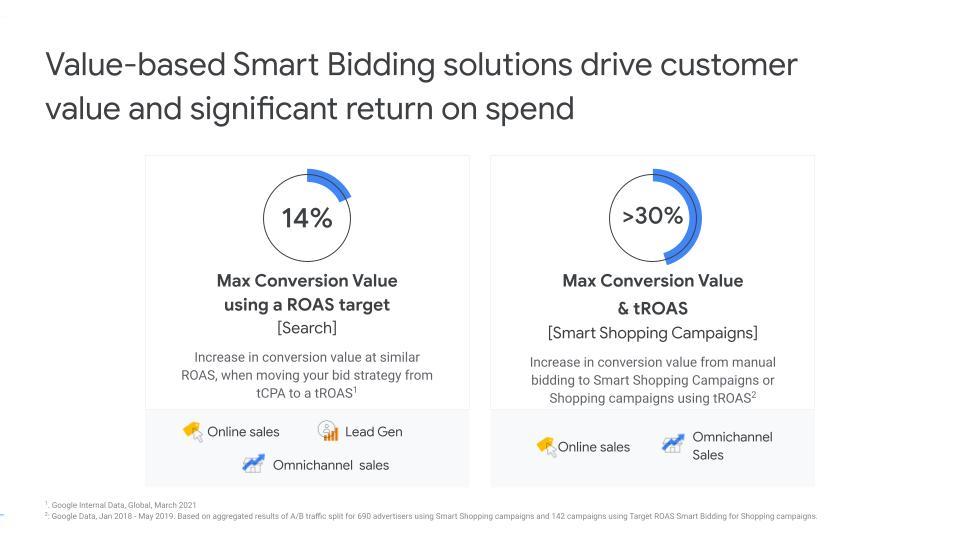
Maximize Conversion Value: This strategy automatically sets bids to help get the highest conversion value within your budget. It’s ideal when you want to maximize the total value of conversions within a specified budget without targeting a specific return.
Target ROAS (Return on Ad Spend): With this approach, you set a target return on ad spend percentage, and Google Ads sets bids to maximize conversion value while trying to achieve your target ROAS. For example, if you set a target ROAS of 400%, you’re telling Google you want $4 in conversion value for every $1 spent on ads.
Both strategies fall under Google’s Smart Bidding umbrella, which uses machine learning to optimize for conversion value in every auction. The key difference is that Maximize Conversion Value focuses purely on maximizing total value, while Target ROAS aims to maintain a specific ratio of value to ad spend.
How to Implement Value-Based Bidding in Your Google Ads Campaigns
Setting up value-based bidding requires careful planning and execution:
- Sign in to your Google Ads account and navigate to your conversion settings.
- Assign monetary values to your conversion actions. You have two approaches:
- Method 1 (Ranking Values): Assign importance rankings to conversions (1, 2, 3, etc.), directing the algorithm to prioritize higher-ranking actions. While simpler, this method lacks precision for ROI calculation.
- Method 2 (Google’s recommendation): Calculate the true business value for each conversion action, considering factors like customer lifetime value and profit margins. This provides a more accurate evaluation of campaign effectiveness.
- Implement value tracking by either:
- Setting transaction-specific values that pass the actual value of each conversion
- Using average values when transaction-specific values aren’t possible
- Choose your bidding strategy (Maximize Conversion Value or Target ROAS) based on your objectives.
Google provides a specialized tool to help calculate appropriate values for different conversion actions, making implementation more straightforward.
What Are the Benefits of Using Value-Based Bidding Strategies?
Value-based bidding offers several significant advantages:
Improved ROI: By optimizing for value rather than just conversion volume, you can significantly improve your return on investment. The system directs more budget toward keywords, audiences, and placements that drive higher-value conversions.
Focus on High-Value Conversions: VBB naturally prioritizes acquisition paths that lead to more valuable customers, helping you build a higher-quality customer base.
Optimized Ad Spend: Rather than spreading your budget evenly across all conversions, your spend is concentrated where it delivers the most business value.
Enhanced Flexibility: Value-based bidding works especially well for businesses with multiple conversion types or varying conversion values, providing a more nuanced approach to bidding.
For ecommerce websites, VBB is standard practice, with the value of each purchase passed back into the interface so campaigns, ad groups, and keywords can be optimized according to ROI.
What Challenges Might Advertisers Face When Using Value-Based Bidding?
Despite its benefits, value-based bidding comes with challenges:
Accurate Value Assignment: Determining the true value of each conversion action can be difficult, especially for lead generation businesses with long sales cycles.
Data Requirements: Effective VBB requires sufficient conversion data. Accounts with limited conversions may struggle to provide enough data for the algorithm to optimize effectively.
Conversion Value Tracking: Setting up proper tracking to capture accurate values for each conversion can be technically challenging.
Algorithmic Bias: Value-based strategies are biased to adapt toward higher-value conversions, which may not always align with broader business objectives.
How Can Advertisers Refine Their Value-Based Bidding Strategies?
To maximize the effectiveness of value-based bidding:
Regular Data Analysis: Continuously analyze performance data and segment actions to make informed decisions about marketing effectiveness.
Testing: Consider testing VBB using Google’s experiment features before fully committing your campaigns.
Balanced Value Assignment: Ensure your value assignments truly reflect both short-term revenue and long-term business value.
Strategy Integration: Remember that success comes from a strategic mindset, not just automation. Advertisers who analyze their business data and plan strategically will outperform those who simply “set it and forget it”.
Value-based bidding represents a powerful evolution in Google Ads’ bidding strategies, allowing for more sophisticated campaign optimization aligned with true business objectives. While it requires more thought and setup than traditional approaches, the potential for improved ROI makes it well worth considering for most advertisers. If you’re interested in NfiniteLimits running your ad campaigns, contact us here.